
Chapter 5: How It Works
On hiking and quest metaphors in AA and IFS

[Backing up to the start of Chapter 5 here.]
[58] RARELY HAVE WE seen a person fail who has thoroughly followed our path.
The Big Book and IFS share hiking as a prominent analogy. Richard Schwartz, the founder of IFS, coined the term “trailhead” to name any feeling, idea, or image that comes up as we begin to settle into a parts session. A trailhead is where a path or multiple paths begin that you can follow. Essential to the analogy in IFS is that you are never hiking alone. You meet up at the trailhead with parts. Or you meet parts along the way.
The imaginative landscape of the parts session as pathway and the twelve steps as a path is a lot like the personification allegories of medieval and early modern literature. The Pilgrim’s Progress might be the most familiar example.
The story begins when the main character, Christian, becomes aware of “a great burden upon his back” and that “our city will be burned with fire from heaven.”[1]
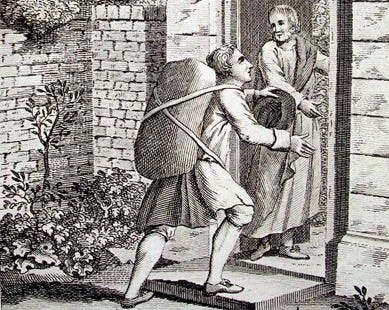

Fortunately, he encounters “Evangelist,” who tells him to journey towards a “shining light” to be released from his burden and find refuge from destruction. This is just the beginning of a long journey, along which he will encounter many characters whom we can recognize as internal parts, such as Mr. Legality, Mr. Worldly Wiseman, Formality, and Faithful. These parts help or hinder Christian—or both—as he must navigate through challenges such as the Slough of Despond and Vanity Fair. The journey is not complete until Christian can be freed of his burden of Sin at the Cross (Steps 5–9), continue to overcome temptations through perseverance (Steps 10 and 11), and counsel and encourage others on his way to the Celestial City (Step 12).
Getting through all of the twelve steps is just one way to be thorough. The other way is to involve all of one’s parts in the journey. The person who is setting out to follow this path is a system of parts under the leadership of the 🔵Self🌼. To be thorough is to engage each of your parts with the 8 Cs, to acknowledge their fears, to recognize the good they desire for you even when they engage in unwanted behavior, and—when it is safe to do so—to invite their participation in the journey of sobriety.
[1] John Bunyan, The Pilgrim’s Progress [1678]; e-text on Project Gutenberg, https://www.gutenberg.org/files/131/131-h/131-h.htm.
All quotations are from Alcoholics Anonymous (New York: Alcoholics Anonymous Publishing, 1955), second edition; https://aamo.info/gsowatch/1955/2ed/. Parenthetical page numbers refer to the corresponding text in the current, fourth edition.

Graphic courtesy Daniel Mitsui: https://www.danielmitsui.com/00_pages/no_ai.html.